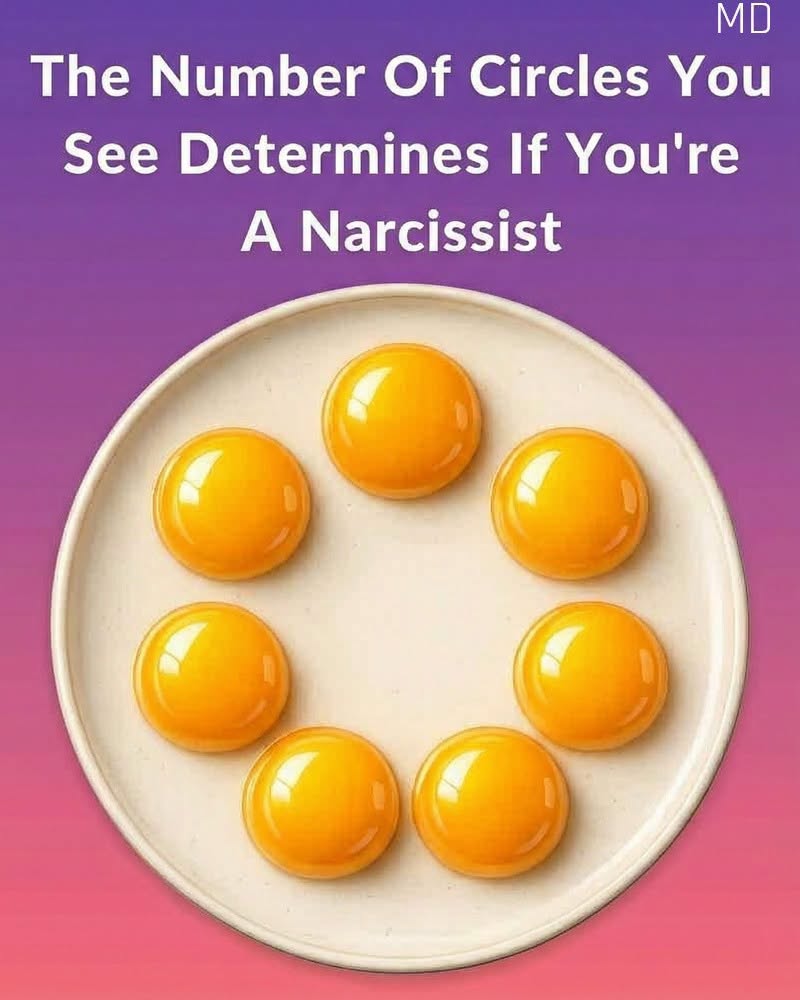
At first glance, the image looks incredibly simple—a plate with several egg yolks arranged in a circle and a playful question asking, “How many circles do you see?” Most people immediately begin counting, confident they’ll arrive at the correct answer within seconds. But as they look a little longer, something interesting happens. Some viewers notice only the most obvious circles, while others begin spotting additional shapes created by the plate, the empty space in the middle, or even subtle details around the image. Before long, what seemed like an easy challenge becomes a fun conversation, with people comparing answers and wondering why they all see something slightly different.
The reason for those different answers lies in how our brains process visual information. Some people naturally focus on the most noticeable objects, counting only the egg yolks because they stand out the most. Others automatically include the plate itself, seeing it as part of the overall design rather than just the background. A few even notice the circular space created in the center of the arrangement, proving that our minds don’t just recognize objects—they also recognize the shapes formed by the spaces between them. None of these approaches is necessarily right or wrong. Instead, they simply show that everyone pays attention to different details when looking at the same picture.
If you spend even more time studying the image, you may discover additional curves, reflections, or patterns created by lighting and perspective. People who enjoy puzzles often slow down and carefully examine every corner before deciding on an answer, while others are happy with their first impression and move on. That’s one of the reasons visual challenges like this are so popular online. They encourage people to take a second look, compare observations with friends and
family, and enjoy seeing how differently each person interprets the exact same image. It’s less about finding a perfect answer and more about discovering how many possibilities your mind can recognize.
Although many social media posts suggest that the number of circles you count reveals hidden personality traits, these claims should be viewed as lighthearted entertainment rather than scientific fact. A single picture cannot accurately measure someone’s personality, intelligence, or behavior. What these puzzles really demonstrate is how differently people observe the world around them. Some naturally notice details, others focus on the bigger picture, and many enjoy searching for hidden patterns simply because it’s fun. In the end, the real value of this challenge isn’t the final number you reach—it’s the curiosity that encourages you to pause, look a little closer, and appreciate how our minds can see the same image in surprisingly different ways.